Saturday, August 11, 2007

2007 Frankfurt Auto Show Preview: Suzuki releases sketch of Kizashi concept

When we first posted on the Suzuki Kizashi concept set to make its debut next month in 2007 Frankfurt Motor Show, we had no idea what the sedan would look like. Suzuki has now given us a hint in the form of an official sketch, and it's a doozy. The new image is exaggerated in the manner many sketches are, depicting a blazing red machine with a front end that resembles the Maybach Exelero in some respects and a chopped roof so low that it looks like it was made by a hot rodder with a cruel sense of humor. We're sure that in person, the proportions of the car will prove to be far more realistic. Kizashi literally means "prelude" according to Suzuki, a nod to this concept's role as a preview of a forthcoming production car.
2007 Frankfurt Auto Show Preview: Suzuki releases sketch of Kizashi concept [Source: Suzuki]

More Excellent Articles About 2007 Frankfurt Auto Show:
+ Subaru at the 2007 Frankfurt Motor Show
+ Mazda6 teaser hits the web, set to debut in 2007 Frankfurt Motor Show
+ New Porsche Cayenne begets new TechArt Magnum
+ 2007 Frankfurt Auto Show Preview: Kia reveals rear shot of Pro-cee'd hatchback
+ 2007 Frankfurt Auto preview: VW to debut rear-engine city car
+ 2007 Frankfurt Motor preview: Renault roadster takes aim at MX-5
+ Iosis X-based Ford Kuga to hit Europe in 08
+ Kia Sports Coupe concept pegged for Frankfurt

Thursday, August 9, 2007

Subaru at the 2007 Frankfurt Motor Show

Fuji Heavy Industries Ltd. (FHI), the maker of Subaru automobiles, today announced the major features of its Subaru exhibit at the 62nd International Motor Show (IAA), which will be held in Frankfurt am Main from September 15 through 23, 2007 (press days are September 11 and 12). Highlights of the Subaru booth this year will be three new models soon to be introduced in many European countries, as well as the Subaru WRC Concept.

Faster than getting a coffee at Starbucks: GT2 laps the 'Ring in 7:32

From its 530 hp, low curb weight of 3,179lbs, and 204 mph top speed, the 2008 Porsche GT2 is a supercar in every sense of the word. Heck, even its €189,496 sticker places Porsche's most potent 911 in the land of the F430 and the Gallardo. Where the Ferrari and the Lamborghini can't match up against the GT2 is where it matters most, on the track. Not just any track, either. We're talking about the track by which all great sports cars are judged... the vaunted 'Ring. Porsche claims the new GT2 can lap the legendary 14-mile course in a mere 7:32, which is 10 seconds better than even the 599 GTB. That ridiculous lap time puts the GT2's average speed at over 110mph, which is just sick. Must be the Titanium exhaust. The 2008 Porsche GT2 is scheduled to appear in Frankfurt in September, and the newest 997 will hit European streets in November.
2008 Porsche 911 GT2
More about
2007 Frankfurt Auto Show:

+ Mazda6 teaser hits the web, set to debut in 2007 Frankfurt Motor Show
+ New Porsche Cayenne begets new TechArt Magnum
+ 2007 Frankfurt Auto Show Preview: Kia reveals rear shot of Pro-cee'd hatchback
+ 2007 Frankfurt Auto preview: VW to debut rear-engine city car
+ 2007 Frankfurt Motor preview: Renault roadster takes aim at MX-5
+ Iosis X-based Ford Kuga to hit Europe in 08
+ Kia Sports Coupe concept pegged for Frankfurt


[Source: Motor Authority]

2008 Porsche 911 GT2 2008 Porsche 911 GT2

Wednesday, August 8, 2007

Castagna Aznom

Back when Top Gear was young and impressionable, we thought a coachbuilder was a mutant amalgamation of a football coach and a bodybuilder - a steroid-pumped, whistle-blowing, press-up dictating maniac.

And, on the evidence of the coachbuilt Castagna Aznom, we weren't too far off the truth.

This snarling lump of supercar is the product of Italian firm Castagna Milano, and it's the scariest thing to come out of Italy since Caligula. (Always on the ball with topical references, us.)

Coachbuilding, of course, is the art of sticking a new body on an existing chassis, and the frame that underpines the Aznom is that of the Corvette Z06.

However, Castagna has bolted a carbon fibre/aluminium frame on top, taking styling cues off the 'Vettes of the 50s and 60s to create a deep-vented, mad-grilled schoolboy fantasy.

A retracting rear wing, F430-esque rear diffuser and fat 20-inch alloys give the Aznom plenty of intent, but we're not so keen on those stuck-on wing mirrors. There are a few more cultured touches inside the cabin, including a Google Earth satnav system.

Castagna has also fettled the Z06's seven-litre V8 up to a massive 750bhp, which should be good for a 0-60mph time of 3.4 seconds and a top speed of 217mph.

And that's before it gets down the gym and puts in some serious reps on the ergs. Or whatever it is that goes on in gyms.

© Source: topgear
We need your comments below >>

Special edition E-Class targets corporate market (UK)

Mercedes-Benz is introducing an extensively equipped and competitively priced special edition of the E-Class Saloon exclusively for the corporate sector. The E-Class Executive ensures time spent on the road is relaxing, productive and above all safe and offers exceptional value at £28,515 on-the-road. That’s £677 less than the E220 CDI Classic on which it is based, yet its enhanced equipment specification is worth an additional £2,543 – representing a saving of £3,220 including VAT over the standard car.

Saab 9-7X Aero - The "WOW!" SUV

Saab Aero Tuning

Saab takes SUV-performance to a new altitude as it announces the Aero performance version of the Saab 9-7X today. The limited edition 9-7X Aero will make its way to dealer showrooms early this autumn. The Saab 9-7X brings unique Saab brand characteristics to the midsize SUV segment, including sophisticated styling inside and out, premium design features, and the sporty and spirited performance inherent to Saab vehicles. Since its debut two years ago, more than 12,000 have been sold in the U.S. and Canada.

For 2008, Saab adds the Aero model - the symbol of serious Saab performance - to the 9-7X lineup. The limited edition 9-7X Aero takes Saab's interpretation on the midsize SUV to an entirely new level accelerating the performance aspect of the sophisticated vehicle with a 6.0L V-8, 20-inch wheels and tires, unique paint and custom interior accouterments.

"The 9-7X Aero is one great SUV to pilot," Shannon said. "We are excited to offer enthusiastic drivers an increased level of performance with the Aero, a symbol of Saab performance, in the midsize SUV segment."

The new 9-7X Aero features a powerful, 6.0L small-block V-8 delivering 390 horsepower (295 kW) and 395 lb.-ft. (542 Nm) of torque. With 0-60 mph acceleration under six seconds, the 9-7X Aero is a treat for those who are actively passionate about the driving experience.

The 9-7X Aero will be easy to spot as it wears a paint color all its own: Carbon Flash Metallic. The charcoal metallic paint nicely enhances the SUV's clean lines. Specific to the 9-7X Aero are 20-inch polished, aluminum wheels wrapped with P255/50R20 V-speed-rated performance tires that provide the optimum balance between ride and handling. Complementing the refined and driver-oriented cockpit-inspired interior are "Aero" embroidered leather seats and embossed floor mats.

Under the hood of the 9-7X Aero is the LS2 6.0L V-8 with a cold air induction package, rated at 390 horsepower (295 kW)* at 6,000 rpm and 395 lb.-ft. of torque (542 Nm)* at 4,000 rpm. The LS2 6.0L is based on the small-block V-8 architecture and delivers excellent down-low torque for strong off-the-line performance. Torque is inherent to the engine's cam-in-block design, which features large 4.00-inch-diameter (101,6 mm) bores and a 3.62-inch (92 mm) stroke. Response is crisp and immediate, thanks to the electronically controlled throttle.
Saab 9-7X Aero
Unique to the 9-7X Aero's version of the engine is a composite intake manifold adapted to the LS2 engine to help produce balanced torque and horsepower. Maximum towing capacity on 9-7X Aero model is 6,600 pounds (2994 kg).

Like all Saabs, the new Saab 9-7X Aero is driver-focused, with a lowered chassis tuned and tested to deliver responsive, balanced handling. Corner control and body roll control are improved with front stabilizer bars that are approximately 10 percent larger in diameter. Additional strength is provided by a heavy-duty rear axle with limited-slip differential.

With a four-wheel disc braking system enhanced with larger, 12.8-inch (325 mm) front disc rotors and iron twin-piston calipers, it's not difficult to put a stop to things in the more powerful 9-7X Aero. The heavy-duty iron calipers are stiff and retain their shape under high-pressure/high-heat braking conditions, providing a more linear feel and reduced pedal travel in high-energy stops. The brake pads use high-performance linings for strong fade resistance.

ABS and automatic all-wheel-drive are standard on all 9-7X models as well as the StabiliTrak electronic stability control system that provides confident, sure-footed travel. The performance-oriented all-wheel-drive system delivers impressive on-road grip and enhanced "launch" feel. The always-engaged system uses a Torsen center differential to split torque between the front and rear wheels. It is a torque-bias system that detects low traction at one axle and directs more torque to the other when needed.

Like all 9-7X models, the Aero model represents a terrific value with a high-level of standard equipment. In fact, the 9-7X boasts the most standard features in its class while offering a very competitive starting price at $39,935. The limited edition 9-7X Aero will start at $45,690, which includes a $745 destination fee and will begin arriving at dealerships this fall.

Saab 9-7X Aero photo

2008 Audi's TT - Get Double Pleasure

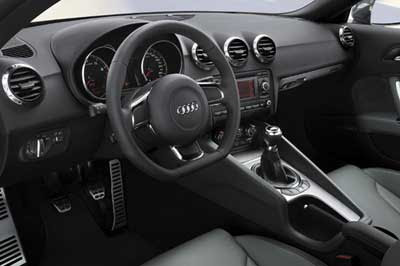
2008 Audi TT inside

If you're looking to splurge on a sporty convertible this summer, be sure to check out Audi's newly redesigned TT. It's quicker, better looking, and more fuel-efficient than the old TT, and you don't have to spend an arm and a leg on the '08 model to get a truly satisfying driving experience. This is one of those rare models where the least-expensive version may be the best.

I recently test-drove the 2.0T version of the '08 TT two-seater roadster with the smaller of the two available engines, a 200-horsepower, 2.0-liter, turbocharged and direct-injected four-banger. And I absolutely love the car.

While the original TT was underpowered unless you went with the six-cylinder engine, the '08 is genuinely quick, even with the smaller power plant. It also has an ingenious ragtop that folds down behind the passenger cabin in a mere 12 seconds while taking up virtually no trunk space. A couple can actually take off for a weekend jaunt in this two-seat convertible without having to choose between keeping the top up or leaving their luggage behind.


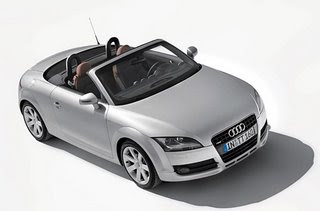
To my eye, the new TT is much better looking than the old one, which may have been an icon but resembled a gigantic bathtub toy. The '08 has hints of the old styling—the sculpted, rounded sides and hood, for instance—but it's less quirky looking. It's five inches longer and three inches wider than the model it replaces and has the lines of a classic sports car.

The '08 2.0T Roadster also gets reasonably good mileage. It's rated at 22 miles per gallon in the city and 29 on the highway, slightly better than the comparable version of the old TT (mainly because extensive use of aluminum kept the '08's weight down). The 2.0T is significantly more efficient than the 3.2T, which is rated at 18 mpg in the city and 24 on the highway.

In 503 miles of mainly lead-footed highway driving, I got a respectable 25.9 mpg in the 2.0T ragtop.

With the smaller engine, the '08 TT ragtop Roadster starts at $37,575. The hardtop version of the car, the 2.0T hatchback Coupe, is even less expensive, starting at $35,575. (The big advantage of the Coupe is that it has child-size fold-down rear seats, while the Roadster comes only as a two-seater.)

New Audi TT

Of course, as always with a German car, you can spend a lot more if you want to. The 3.2 liter, 250-horsepower, six-cylinder engine is only available in all-wheel-drive versions of the '08 TT (the 2.0T has front-wheel drive). The 3.2 Quattro TT ragtop roadster starts at $45,275 for a stick shift and $46,675 with an automatic. The 3.2 Quattro version of the hardtop Coupe starts at $42,225 with a stick shift and $43,675 with an automatic.

Early indications are that the new TT is going to sell very well. U.S. sales of the TT were up 205.4%, to 1,652 units in the first half of 2007, even though the new model hit showrooms only in April. Sales were up 371.4%, to 495 units in the month of June.

Audi, a unit of Volkswagen, saw its overall U.S. unit sales rise 13%, to 45,711 in the first half.

The turbocharged engine in my loaner Audi TTwas one of the most impressive four-cylinder power plants I've ever tested. It generates 20 horsepower more than the 1.8-liter, four-cylinder engine in the old TT, which is enough to give the '08 significantly more pep. I got 0-to-60 times of a little over six seconds in the '08 TT with an automatic transmission, which is nearly two seconds faster than the old TT.

One reason the TT is so quick is that Audi's S tronic automatic transmission is one of the smoothest and fastest-shifting in existence. I got about the same 0-to-60 times whether I put the automatic into the sport setting and just punched the gas pedal, letting the transmission do the work, or if I had it in manual mode and used the paddle shifters to change gears myself.
2008 Audi TT

The TT also now has a feature that Audi calls "Launch Control" (I kid you not). You turn off the electronic stability control (by pushing a button on the center console), shift the transmission into the sport mode with your left foot firmly on the brake, then hold the accelerator down with your right foot for at least one second while the engine revs up to 3,200 revolutions per minute.

The effect when you take your foot off the brake is very similar to revving the engine and popping the clutch in a car with a stick shift: The front tires squeal and the TT takes off like a mini-rocket. My 0-to-60 times in the 2.0T Roadster dropped to a consistent 5.9 seconds when I used Launch Control, which is only one tenth of a second slower than the more expensive (but 300 pounds heavier) 3.2 Quattro TT with the six-cylinder engine and all-wheel drive.

The S tronic automatic has a double clutch system in which two independent clutches replace the torque converter found in most automatic transmissions. So the TT accelerates with no noticeable pause when it shifts gears. Yet the exhaust note sounds like there's a professional driver doing the shifting, even when you just let the transmission do the shifting. The engine pops and crackles and has a satisfying growl as you put the TT through its paces.

Audi TT Roadster

The Roadster's cabin remains relatively calm and quiet, even with the top down at highway speed. That's largely because of a windscreen that you can raise up behind the rear seats at the push of a button. Another cool feature is the automatic spoiler on the rear deck. It deploys as soon as you top 75 mph and goes down when your speed drops back down below 50 mph. It really does seem to make the car hug the road a bit tighter at high speeds.

I have mixed reactions to the TT's interior. It's well laid out and has some cool features that emphasize the car's sportiness, such as the macho-looking aluminum "dead pedal" (you brace your left foot against it during hard driving) and the flat-bottomed steering wheel.

But legroom is fairly limited and I suspect that tall drivers will feel cramped. I also could have done without the synthetic suede inserts in my test car's upholstery, which seemed likely to pick up dirt and wear poorly. I'd prefer all-leather upholstery, though that costs an extra $1,250. I also wish Audi's designers would find some way of making the TT's tiny sun visors a little bigger. When you're driving into the sun, they're almost useless.

It's lucky the TT Roadster's trunk is relatively big, because storage space in the main compartment is in short supply. There are small bins in the bottoms of each door, as well as a small, lockable storage compartment between the seats on the back wall of the passenger compartment. But space in the glove box is limited, and shrinks to almost nothing when the optional CD changer is stowed there.

If you're going to buy a TT, my strong advice is to save money by going with the 2.0T. The 3.2T with the more powerful engine adds almost nothing when it comes to performance and is significantly less fuel-efficient.

True, the 3.2T comes with more standard equipment, but if you add the $3,050 Premium Package to the 2.0T the two models are comparably equipped and you still save about $5,000. (The package includes the power folding top, a three-spoke sport steering wheel with paddle shifters, a six-CD changer, heated and power seats, rain-sensing wipers, and an auto-dimming interior mirror.)

The main competing models to consider in the same price range are the BMW Z4 and the Mercedes-Benz SLK280 from DaimlerChrysler .The '08 TT has been selling for an average of $45,366, according to the Power Information Network, while the Z4 has been going for $43,216 and the SLK280 for $46,366.

However, if you stick with the 2.0T version of the Audi, you can end up paying less than the average, even including the premium package. And the TT is better looking than the BMW and, at least with an automatic transmission, is more fun to drive than either the BMW or Mercedes.
If you're on a tight budget, consider the Nissan 350Z, which has been selling for an average of $33,272, according to PIN . And if you're still tempted by the more expensive Audi 3.2T, consider the mid-engine Porsche Boxster instead. It sells for an average of $51,879, but its superior rear-wheel-drive handling characteristics are worth the extra money.